Finding your podcast niche.
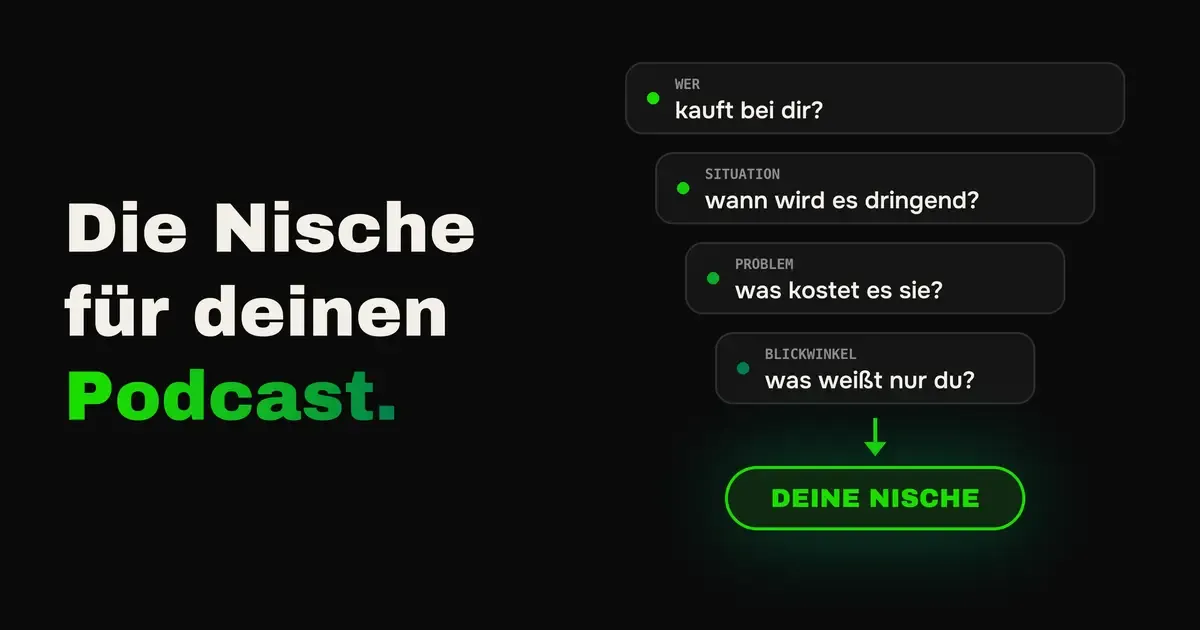
How to find a topic your ideal clients cannot get past.
Most business podcasts do not fail because of the technology but because they speak to everyone and are therefore important to no one.
You derive your podcast niche from your offer, meaning who buys from you, in which situation and with which problem. From that you build a podcast these people cannot ignore. For that you do not need the masses, you need the right ones.
Why a podcast for everyone helps no one
- There are enough listeners: According to the German digital association Bitkom, 54 percent of Germans aged 16 and over listen to podcasts at least occasionally (September 2026). A year earlier it was 49 percent.
- And enough competition: Around 4.7 million podcasts are registered worldwide, and around 480,000 of them have published an episode in the last 90 days according to Podcast Index (2026). With “business”, “success” or “marketing” you are one of thousands.
- Most do not last: Of 193,413 podcasts that seriously launched in 2025, fewer than 40 percent are still publishing new episodes according to Podchaser.
Three mistakes are especially common.
- The topic follows passion, not the offer: An accountant who talks about motivation hardly wins clients with it, because nobody makes the connection.
- The podcast speaks to peers: Talking shop among experts feels good, but peers do not buy from you, and your customers tune out.
- The audience is “all business owners”: Whoever addresses everyone makes nobody think “this is exactly for me”.
How many listeners you really need
- The real numbers: According to Buzzsprout, the median podcast gets 27 downloads per episode in the first seven days. With 96 you are in the top quarter, with 412 in the top 10 percent (as of September 2026). What the numbers mean is in the article Understanding podcast statistics.
- 100 right ones beat 10,000 random ones: 100 managing directors from your target industry who listen to you for half an hour every week would be a full hall at any industry talk.
- The 95:5 rule: According to research by John Dawes of the Ehrenberg-Bass Institute, published in 2021 with LinkedIn’s B2B Institute, only about 5 percent of B2B buyers are actively looking for a provider at any given time. A podcast in your niche makes sure the other 95 percent think of you when they are ready.
How this effect works in sales, with numbers from Gartner and 6sense, is in the article Podcasts in the marketing funnel.
Deriving the niche from your offer
At Studio M we start with every client at their offer. We clarify what exactly they sell, to whom and which problem they solve. Only then do we define what kind of podcast and which topics build on that. The goal is a podcast you have to know in its niche, because there an expert from the niche speaks for the niche.
Why this works is shown by the 2025 B2B Thought Leadership Report by Edelman and LinkedIn with 1,934 executives. In the final decision for a provider, 85 percent say it matters that the provider understands their company’s specific challenges, 76 percent that they understand industry trends, and 74 percent that they are regarded as a leading expert. And 53 percent say a brand’s familiarity matters less when its expert content is strong. That is exactly what a niche podcast can deliver.
Four questions get you to your niche.
- Who buys from you? Describe a role and a situation, such as owners of trade businesses with 10 to 50 employees.
- In which situation? When does your offer become urgent: at succession, with the first employee, after a failed project?
- Which expensive problem? What does it cost your customers in money, time or nerves if they do not solve it?
- What is your point of view? What do you know from experience that others do not say? According to Edelman, 86 percent of decision-makers that sales never speaks to directly want perspectives that challenge their assumptions.
From that comes your show promise in one sentence. “For [who] in [situation] who [goal or problem], with [your point of view].” It belongs in title, description and cover so everyone immediately knows whether they are meant.
Two examples from our work
- PreSales Unleashed: In the German-speaking presales market, meaning the professionals who handle technical consulting before the close in B2B software sales, there was no established podcast presence. The founders filled this gap. Today, by their own account, the podcast is their most important marketing channel, acquisition channel and source of LinkedIn content all at once.
- Dein Höhenweg: Noreen Eickenberg is a sports mental coach and talks about mental strength in equestrian sport. It hardly gets narrower, and that is exactly what works. Through her podcast she wins new clients several times a month.
Test your niche before you start
- 30 episode topics from real questions: Collect 30 questions that customers and prospects have actually asked you, from emails, intro calls and comments. Each is an episode topic that someone is guaranteed to want to hear. If you cannot think of 30, the niche is too narrow or you do not know it well enough yet.
- 20 dream guests: Note 20 specific people from the niche, ideally ones who could also be customers. Guests also make your podcast more durable. According to Podchaser, of shows with 26 to 52 episodes, 67 percent of those with guests are still publishing, but only 50 percent of those without.
- The competition check: Search Apple Podcasts, Spotify and YouTube for your topic. If there are ten similar podcasts, you need a sharper point of view. If there are none, check via Google and LinkedIn whether the people and their questions really exist.
- Five conversations: Tell five people from the niche your show promise. If they ask when the first episode is coming, you have your niche.
Too narrow or too broad?
What matters is not how many people there are in your niche, but whether enough of them could buy from you.
- Too broad is when your podcast title could come from a hundred others, your listeners would not buy from you, or you cannot name specific dream guests.
- Too narrow is when you cannot think of 30 topics, there are fewer potential customers than you need, or you repeat yourself after ten episodes.
- When in doubt, start narrow: You can expand once you have made a name for yourself. The other way around rarely works.
One niche, four listener types
Even in a clear niche, not everyone listens the same way. A model going back to the psychologists Fritz Riemann and Christoph Thomann, widespread in rhetoric, distinguishes four basic needs. Every person carries all four in different strengths.
- Closeness: These listeners want to experience people, personal stories, real guests, a stance.
- Distance: These listeners want facts, numbers, studies and clear results.
- Permanence: These listeners want order, a common thread, traceable steps and a summary.
- Change: These listeners want something new, ideas, trends and a conversation with pace.
So plan something for all four into every episode: a personal story, a number, a clear structure and an outlook.
Typical niche mistakes
- Changing the topic after five episodes: Trust needs repetition. A fixed rhythm helps: according to Podchaser, shows that come out about every two weeks are more often still active (44 percent) than weekly (39 percent) or daily ones (28 percent).
- Guests from your own bubble: Invite people who are or could be your customers, not just peers and friends.
- Famous instead of fitting: A well-known guest may bring reach, a guest from your niche brings trust and sometimes an order.
- The promise only in your head: It belongs in title, description, cover and the first 30 seconds of every episode.
Bonus
The AI prompt for your podcast niche
This prompt works like a strategy conversation. If it is missing important information, it asks first. Then it calculates how many customers you need for your goal, compares three niches with points, looks for the biggest weakness in each and fully develops the best one.
It works in ChatGPT, Claude and Gemini, ideally with a model that thinks at length and with web search switched on. Take half an hour for the inputs. The more real questions and customer descriptions you paste in, the better the result. Invented customers deliver invented niches.
Prompt
You are a podcast strategist for business owners, consultants and experts. You do not measure a business podcast by downloads but by how many listeners become customers. Your task is to find the niche for my podcast with me, meaning the topic and the listener group where listening is most likely to turn into an order. ## How you recognize a good result – The listeners can buy my offer, and there are enough of them for my goal. – The topic carries at least 50 episodes without me repeating myself. – My experience makes me credible in this niche. – Someone from the target audience reads the title and immediately thinks “this is for me”. ## My offer [What do you sell, in what form, at what price? How big is an average order?] ## My goal [How many new customers per year should the podcast bring? Are there other goals, e.g. partners, employees, visibility in an industry?] ## My best customers [3 to 5 real customers, without names: role, industry, company size, what triggered the purchase, problem before, result after, why they chose you] ## Customers I no longer want [Who does not fit you and why?] ## Real questions [10 to 30 questions from customers and prospects, verbatim from emails, intro calls and comments] ## My point of view [Your experience, method or stance. Where do you contradict the prevailing opinion in your industry?] ## Framework [Language and region, time per week, audio or video, ideas you already have] ## Procedure 1. Check my inputs. If something is missing that would significantly change the result, first ask me at most five targeted questions and wait for my answers. Otherwise start right away. 2. Look for the patterns. Which roles, situations and triggers keep appearing? Sort the real questions by topic and by how close they are to a purchase: understanding the problem, comparing solutions or choosing a provider. 3. Do the math. How many customers do I need for my goal? Estimate for each niche how many suitable companies or people there are in my region, and mark every estimate as an assumption with a short reason. 4. Develop three clearly different niches: a narrow one, a medium one and a bold one that clearly sets me apart from others. 5. Check the competition. If you can search the web, name existing podcasts for each niche on Apple Podcasts, Spotify and YouTube. If you cannot, give me the search terms to check myself. 6. Score each niche from 1 to 5 points on purchase proximity of the listeners, size of the target audience relative to my goal, topics for 50 episodes, guests who could also be customers, distance from existing podcasts and my credibility. Justify every number in one sentence. 7. Be your own critic. Name for each niche the strongest reason why it could fail. 8. Recommend one niche and develop only that one in detail. ## Output A. Short analysis, the most important patterns from customers and questions in at most five points. B. Comparison table of the three niches with points, total and biggest risk. C. The recommended niche in detail: – Show promise in one sentence: For [who] in [situation] who [goal or problem], with [my point of view]. – Five title suggestions that are understood without explanation, no puns, plus a description for Spotify and Apple Podcasts in two sentences. – Format: solo, interview or mix, length and rhythm, each with reasoning. – 30 episode topics as a table with working title, underlying customer question and purchase proximity (early, medium, close to purchase). At least a third is close to purchase. – 10 guest profiles as role and situation, without invented names, each with the reason why they interest my listeners and why they themselves could be a customer. – The first three episodes, each with one sentence on why they are suitable for the start. – A test for the next 14 days with which I check the niche before launch, including three questions for conversations with people from the target audience. ## Rules – Do not invent facts, numbers, studies, people or podcasts. Mark estimates as assumptions. – Use my customers’ language from the real questions, no marketing speak. – No general tips that apply to every podcast. Every statement refers to my inputs. – Reply in English.
Take the result as a starting point, not a decision, and actually carry out the 14-day test before you record the first episode.
Conclusion on the podcast niche
The right niche is not a question of taste but of your offer. Whoever knows who buys from them, in which situation and with which problem, builds a podcast these people cannot get past. A hundred right listeners per episode is a full hall, and many of them will become customers at some point.
Frequently asked questions
It is a clearly defined topic for a clearly defined group of listeners. For business owners it follows from their own offer, meaning who buys from them, in which situation and with which problem.
Answer four questions. Who buys from you, in which situation, with which expensive problem, and what is your point of view? From that you phrase a show promise in one sentence and test it with 30 episode topics from real customer questions, 20 dream guests and a look at existing podcasts.
Fewer than most people think. According to Buzzsprout, the median podcast has 27 downloads in the first week, with 96 you are in the top quarter. For business owners what counts is whether the right people are listening. 100 decision-makers from your target industry are worth more than 10,000 random listeners.
That rarely happens. It is only too small if you cannot think of 30 topics or there are fewer potential customers than you need. When in doubt, start narrow and expand later.
According to the model by Riemann and Thomann, listeners seek closeness, distance, permanence or change, meaning personal stories, facts, structure or new ideas. Whoever plans something for all four into every episode keeps more listeners until the end.