Editing your own podcast.
What really awaits you, what AI can do about it, and when outsourcing pays off.
Of course you can edit your podcast yourself, the software is even free. The question that actually matters is a different one: do you want to do this every single week on top of your real job?
My team and I have produced more than 6,300 episodes. For half an hour of audio we need roughly one hour of post-production, and we do nothing else all day. Anyone editing a podcast next to a job or their own business needs a few hours more. In this article we work out what that costs you and look at why AI does not take this work off your plate yet, even though that is being promised everywhere right now.
Are you sure you want to do this yourself?
If your podcast is a hobby, go ahead and edit it yourself. The evening at the laptop is not a chore then but part of the fun, and whether the episode comes out a week later does not matter.
If you are a business owner and want to win clients with your podcast, the math looks different. Editing does not just mean removing a few ums. It means listening to the whole episode, deciding what is relevant and what is not, and doing it in a way that nobody notices in the end. Every hour you spend in the audio track is an hour you do not have for clients, proposals and your team. And it does not stop at one evening, because a podcast lives on being published regularly. So you edit every week, on vacation too, and even when a big project is running.
“You have to have done it yourself once”
You are guaranteed to hear this sentence as soon as outsourcing comes up. In the 80s and 90s it may have been advice that business owners passed on to each other, and maybe it was even true back then. Today it is no longer relevant, just outdated.
You do not have to have edited an episode yourself to hear whether your episode sounds good. Just as you do not have to have coded your website yourself to see whether it brings clients. Outsourcing is not a shortcut but a perfectly normal business decision.
What editing yourself costs you per year
Tim and Jan from the podcast PreSales Unleashed edited everything themselves at the beginning and needed 5 to 6 hours per episode. They quickly realized that this was far more work than expected, and that their hour was too expensive for tasks that can be handed off more cheaply. Let’s do the math.
| Do it yourself | Outsource | |
|---|---|---|
| Per episode | 5 to 6 hours | Record and approve the finished episode |
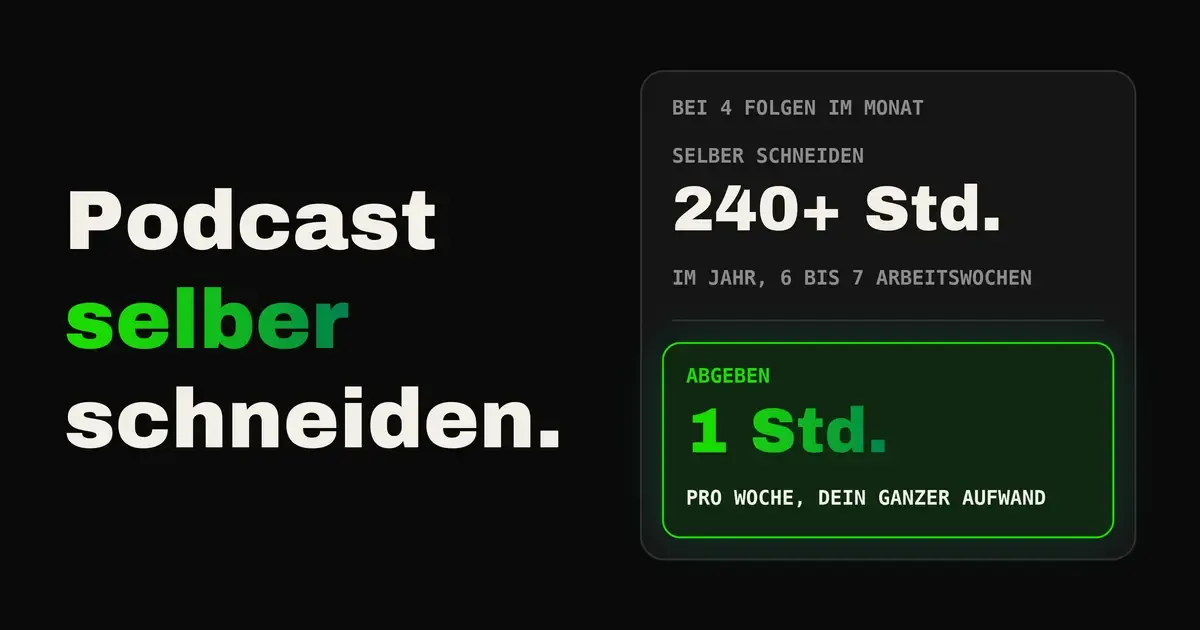
| Per month with 4 episodes | 20 to 24 hours | approx. 4 hours, so one hour per week |
| Per year | 240 to 288 hours, six to seven full working weeks | approx. 48 hours |
| Money | €0 for a free program | with us from €200 per episode, with video from €300 |
Example calculation with 4 episodes per month, approximate and subject to change.
So the question is not whether outsourcing costs money, but what six working weeks a year are worth to you. Plug in your own hourly rate. Even at €50 per hour, 240 hours add up to €12,000 a year, and that is time in which you are not looking after clients or writing a single proposal.
Even the podcast host Buzzsprout dedicates a separate section to editing in its guide on why podcasts quit. One of its tips is to hand off the editing.
Editing a podcast with AI, and what that really means
Almost every editing program now advertises AI. Riverside promises that you edit episodes in minutes. At Descript, an AI called Underlord creates the rough cut, and Adobe promises studio-quality voices with Enhance Speech. That sounds as if editing were a solved problem. It is not, and for a reason no ad mentions.
- You have to direct the AI: It does not know what matters in your episode. You have to tell it what goes, what has to stay and how it should sound in the end.
- You run feedback loops: The first result rarely fits. So you listen back, correct, let it try again and listen back once more, until it is the way you imagined.
- You have to dig into it: Every platform works differently, new platforms keep appearing, and it feels like there is a new feature or a new update every week.
- You pay for it: The features that actually help are mostly locked in paid plans. At Riverside, for example, automatic removal of pauses and filler words is part of the Pro plan.
You go from editor to manager of an AI, assigning tasks, checking results and asking for revisions. You still do not gain any time.
That does not mean AI is useless. When it comes to creating something new, meaning text, ideas or drafts, it is strong. But when an existing recording of people needs to be edited, it is still too coarse for audio and video. It takes a human to check the result and fix it. Give the technology another six to twelve months and it may get close. Until then you have two sensible paths. You wait, or you hand the editing to people whose job this is every day and who know exactly when and where AI actually helps and when it does not.
What AI can already handle well around your podcast today is covered in the article Automating your podcast with AI.
With a video podcast, everything doubles
With video, the picture joins the audio track, and every cut in the audio is also a cut in the picture. Who is on screen right now, when the camera switches and how an hour of conversation turns into a short clip for LinkedIn: these are countless small decisions that need a feel for the conversation.
This is exactly where AI struggles most. Automatic camera switching and clips do exist, Riverside offers both for example. But here too, someone has to watch every result and fix it, and with video every mistake is visible.
The clips an AI picks are good, no question. But it does not find the real gold nuggets, because it mainly analyzes the transcript and then weighs which statement might work. Often it is the small moments, a facial expression, a pause or a nuance that an AI does not see but a human does. A human feels the emotions. An AI never will.
How to recognize a good editor
- Before-and-after samples: Ask to hear how a raw recording sounded before and after. You can find ours on the page Podcast editing service.
- Content editing, not just ums: Ask whether they also shorten, and who decides what gets cut. A good editor makes sure the conversation flows.
- A fixed contact person: Someone should know your podcast so they do not have to be onboarded again for every episode.
- A clear turnaround: With us, an episode is usually ready 4 to 5 days after recording.
- Everything from one source: Show notes, upload and, for video, thumbnail and clips should be included. Otherwise you end up coordinating three freelancers instead of one.
- No long contract: You should be able to pause or stop if it does not fit. With us you can pause free of charge at any time.
What to look for if you want to hand off not just the editing but the whole podcast is covered in the article Finding the right podcast agency.
Bonus
What does your own editing cost you?
Enter your own numbers. The defaults are the values from the calculation above: four episodes a month, five hours per episode and an hourly rate of €50.
- Hours of editing per year:
- That is this many full working weeks:
- That is what this time is worth:
Not included is what you could do for your business in those hours instead.
For comparison, with us you get editing and mastering for an audio podcast from €200 per episode, with video from €300.
Conclusion on podcast editing
Editing a podcast yourself is possible, and as a hobby there is nothing wrong with it. As a business owner it costs you hours every week that are worth more than what outsourcing costs. AI changes little about that today, it just shifts the work from editing to directing and checking. Put your time into good conversations instead, and hand the editing to people who do it every day.
Frequently asked questions
Yes, there are plenty of free programs. As a business owner, though, you should expect several hours per episode, every week. Even a practiced team needs roughly one hour of post-production for half an hour of audio.
Not well enough yet, because tools like Riverside, Descript or Adobe Podcast only help with individual tasks. Someone has to direct the AI, listen to every result and fix it, so you shift the work instead of saving it.
A practiced team needs roughly one hour of post-production for half an hour of audio. Anyone doing this next to a job needs a few hours more, often 5 to 6 hours per episode at the start.
With us from €200 per episode for an audio podcast and from €300 per episode with video. That covers the content edit, mastering and personal support. Intro and outro, show notes and publishing are available on request. You can find an overview of all costs in the article How much does a podcast cost?
For business owners it almost always is. With four episodes a month, editing yourself quickly costs you 240 hours and more per year. Outsourcing costs money but saves you that time, and your own effort drops to about one hour per week.