Parasocial relationships in podcasts.
Why your listeners trust you but hardly ever write, and how to change that.
Your listeners know your voice, your stories and your opinions. You do not even know most of their names.
That is exactly a parasocial relationship. It is the reason a podcast builds so much trust, and at the same time its biggest problem, because it stays one-sided. The supreme discipline in podcasting is therefore turning the one-sided relationship into a two-sided one. Whoever manages that gets topics, guest requests and questions from their listeners, meaning real data instead of guesses.
What a parasocial relationship is
The term was coined by the sociologists Donald Horton and Richard Wohl in 1956, back then with radio and television hosts in mind. They described a closeness at a distance. The audience feels familiar with a person, as if they knew them, although that person knows nothing about them. Today you encounter this with influencers, streamers and even AI chatbots. In podcasts it is particularly strong.
- The voice in the ear: Your listener wears headphones and has no screen and no feed in front of them. You speak to a single person, not to an audience.
- The fixed place in daily life: Your episode plays while jogging, in the car or while cooking, every week again. That way you become part of a routine.
- A lot of time in one go: People listen to an episode for longer than anyone ever looks at one of your posts.
- The imperfect: In The Podcast Study 2026 (1,205 respondents in the US), 82 percent of podcast listeners say the host is a big part of, or even the only reason, they listen to their favorite podcast. Closeness comes from the person, not from a flawless recording.
What the relationship brings you as a business owner
- Trust before the first conversation: An analysis of over 12,000 listener reviews of two long-running US podcasts shows that above all host and content carry trust and closeness (Media and Communication, 2025). Whoever has listened to you for months does not come to the intro call as a stranger.
- Your recommendations work: In an experiment in the Journal of Consumer Marketing (2023), the stronger listeners’ parasocial relationship with the host, the less critically they examined an advertising message spoken by the host, and the more likely they were to want to learn about the brand. So when you talk about your own offer, people who already trust you are listening.
- Clients who come on their own: How this works in sales, with numbers from Gartner and 6sense, is in the article Podcasts in the marketing funnel.
Everyone listens, hardly anyone writes
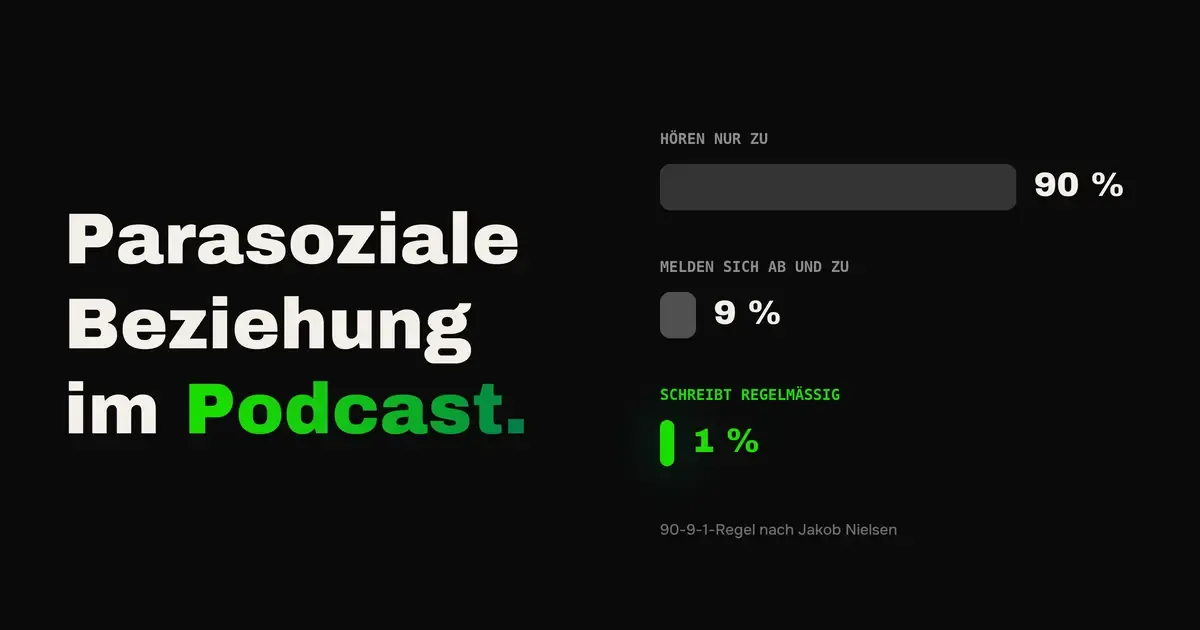
The relationship is there, but it only runs in one direction. That is not a podcast problem but a well-known pattern online. According to Jakob Nielsen’s 90-9-1 rule (2006), in online communities about 90 percent only read along, 9 percent participate occasionally and 1 percent delivers the bulk of contributions. With podcasts the hurdle is even higher, because whoever is listening often does not have their hands free.
On top of that, not every platform even allows a reply.
- Spotify: Since 2024 there have been comments under episodes. German comments have appeared automatically since April 2025 if they comply with the rules. You can reply via Spotify for Creators.
- YouTube: Comments under every episode, for video podcasts usually the liveliest place. How to become visible there is in the article Uploading your podcast to YouTube.
- Apple Podcasts: Here there are only star ratings and reviews, but no comments.
- All other channels: These include LinkedIn, Instagram, email, newsletter and the contact form. With our clients, listeners get in touch through all these routes, often without warning and after many episodes listened to.
How one-sided becomes two-sided
- One concrete question per episode: “Feel free to write to me” achieves nothing. “Which guest do you want to hear here next?” gets answers. Ask one question via one channel, at the end of the episode and in the show notes.
- Ask for guests and topics: Your listeners know exactly whom they want to hear and what they are missing. Ask them instead of guessing.
- Answer in the next episode: Read the question out and mention the name if the person agrees. That way everyone else sees that writing pays off. PreSales Unleashed turns this into dedicated episodes with listener questions.
- Reply personally: A message to you is a big step. A reply from you yourself, not from an assistant, turns the feeling of knowing you into a real conversation.
- Show yourself as a human: Tell what went wrong, what you think and what is on your mind right now. That is exactly what listeners name when describing why they believe a host.
- Keep the path short: A link in the show notes and one sentence at the end of the episode are enough, always for the same channel. Every additional click costs you messages.
Data instead of guessing
Every message from your listeners is a small data point. Collected, they tell you more than any download statistic.
- Topics: Questions that keep coming are your next episodes. How to build a whole topic list from them is in the article Finding your podcast niche.
- Guests: Whom your listeners want to hear tells you whom they trust and where they currently stand.
- Formats: Whether shorter, longer, with more practice or more interviews, your listeners tell you if you ask.
- Language: The words your listeners write with belong in your titles and descriptions, because that is exactly how they search.
That pays off twice. According to Spotify, listeners who interact with a show come back four times as often within 30 days and listen to twice as many hours a month on average (2024). That does not prove the comment is the cause, but whoever writes, stays.
Two examples from our work
- Dein Höhenweg: Noreen Eickenberg talks as a sports mental coach about mental strength in equestrian sport. Her listeners get in touch through every channel, usually after listening to several episodes, seemingly out of nowhere. By then the relationship has long been there. Through her podcast, Noreen wins new clients several times a month.
- PreSales Unleashed: Tim Brömme and Jan-Erik Jank have been talking about presales in B2B software sales since 2018, by now in over 280 episodes and, according to their website, to more than 2,500 listeners a month. Their listeners send topic and guest requests, and the two answer listener questions in dedicated episodes. They now additionally run their own community, the PreSales Leadership Community with over 250 executives, monthly online sessions and evenings in cities like Munich and Frankfurt.
Limits and typical mistakes
- Exploiting the closeness: If listeners approach your recommendation less critically, that is a responsibility, not a free pass. You clearly label paid advertising, and you only recommend what you are convinced of.
- Only asking, never giving: Subscribe, rate, share, write, all in one episode. Whoever constantly wants something comes across as advertising, not as a conversation partner.
- Asking questions and never answering: Whoever writes into the void once does not write a second time.
- Too many channels: Better one channel you really maintain than five you half look after.
- Changes without explanation: According to the study with the 12,000 reviews, changes in host or content trigger nostalgic reactions, positive and negative. If you plan a new co-host, a new format or a new topic, tell your listeners beforehand why.
Bonus
The AI prompt that analyzes your listeners
For two or three months, collect everything your listeners write to you in a single document: comments, messages, reviews and questions from intro calls. Write each voice in its own paragraph, if possible with channel and date. Remove names and contact details before you paste anything into an AI.
The prompt works like a small content analysis. It first classifies every single voice according to fixed rules and only then counts. It backs every recommendation with the voices it comes from, so you can verify everything. At the end you get the next five episodes by priority and a status you paste in again at the next analysis. It works in ChatGPT, Claude and Gemini, ideally with a model that thinks at length.
Prompt
You are the managing editor of a business podcast and you work like a market researcher. You analyze my listeners’ real voices according to fixed rules so I know which episodes, guests and formats they really want. Accuracy matters more than completeness. Better a cautious statement with evidence than a strong one without. ## My podcast [Name, topic, who it is for, rhythm, format] ## My offer [What do you sell, to whom, in which situation do your customers buy?] ## Previous episodes [Titles of the last 10 to 30 episodes, the most listened to marked] ## Last status (only from the second analysis on) [Paste the section “Status for the next analysis” from your last analysis] ## Listener voices [Paste all voices, one per paragraph, without names and contact details, if possible with channel and date, e.g. “Spotify, March 12: …”] ## Working rules – Number the voices in the order they appear as V1, V2, V3 and so on. You back every statement, number and recommendation with these numbers. – Count voices, not mentions. If one voice raises a topic three times, it counts once. One voice may be assigned to several topics. – A topic needs at least two voices. Everything else you list as a single voice. – You copy quotes verbatim and unchanged. Do not summarize or improve them. – If names, email addresses or phone numbers are still in the material, replace them with [removed]. – Always separate what the listeners say from what you conclude from it. You mark conclusions with “Interpretation”. – Invent nothing: no voices, numbers, guests or quotes. ## Procedure Step 1, check. Count the voices and name the channels and the period. If there are fewer than 15, say clearly that the analysis only provides indications. If information about podcast or offer is missing, ask me at most three questions and wait. If there are more than 150 voices, suggest working in parts. Step 2, coding. Classify every voice in a table with these columns: – No. – Channel – Type, exactly one of: question, topic request, guest request, format request, problem, praise, criticism, other – Topic, briefly in your own words – Key quote, verbatim, at most 20 words – Purchase proximity 0 to 2: 0 no relation to my offer, 1 a problem my offer touches, 2 recognizable need or request for collaboration With more than 40 voices, do not output this table but work with it internally and show excerpts only on request. Step 3, analysis. Summarize the coding and check every number again against the table. Step 4, priority. Score every topic with this formula: number of voices × (1 + average purchase proximity), plus 2 if no episode exists on it yet. Show the calculation openly. Step 5, self-check. Before output, check whether every number is correct, every quote verbatim and every recommendation backed. Correct errors before you answer. ## Output A. Overview: number of voices, channels, period, validity in one sentence. B. Topic table sorted by priority: topic, number of voices, supporting numbers, one typical quote, already covered yes or no, priority with calculation. C. Guest requests: named people and requested roles, number, voice numbers and what listeners expect from this guest. D. Format requests with number, voice numbers and your interpretation. E. The next five episodes by priority, each with a working title in the listeners’ language, three questions the episode must answer, a fitting guest or role and the numbers it is based on. F. Purchase signals: only voices with purchase proximity 2, with number and reasoning, without inferring individuals. G. Three questions for the end of the next episode, one each for Spotify comments, YouTube comments and LinkedIn, phrased so they can be answered in one sentence. H. What has changed since the last status, only if I pasted one in. I. Status for the next analysis: the ten most important topics with numbers, the open guest requests and the date, in at most 150 words, so I can paste it in next time. Reply in English, no general podcast tips.
Repeat the analysis every three months and paste in the last status each time. That way you see which topics are growing and whether your episodes really answer your listeners’ questions.
Conclusion on parasocial relationships in podcasts
No other medium builds as much closeness as a podcast, but at first this closeness only runs in one direction. Whoever deliberately asks their listeners, answers them and brings their wishes into the next episodes turns listeners into conversation partners and conversation partners into clients. And they know what to record next instead of guessing.
Frequently asked questions
A one-sided relationship in which people feel familiar with a media personality although that person does not know them. The term was coined by Donald Horton and Richard Wohl in 1956. Today it applies to hosts, influencers, streamers and podcast hosts.
Because the voice is right in the ear, episodes become a fixed part of daily life and listeners often listen to a host for half an hour or more in one go. Add the imperfect: spontaneity, mistakes and personal details make a host feel real.
Not fundamentally, because they arise in every medium in which a person appears regularly. It becomes critical when someone exploits the closeness, for example with unlabeled advertising or recommendations they do not stand behind.
Ask a concrete question at the end of every episode, name a single channel for it and answer the best messages in the next episode. Reply to everyone personally. Whoever sees that writing has an effect is more likely to write.
On Spotify under every episode, in German since April 2025 with automatic publication, and on YouTube. Apple Podcasts only allows ratings and reviews. With business podcasts, many messages also come via LinkedIn, Instagram and email.