Speaking better on your podcast.
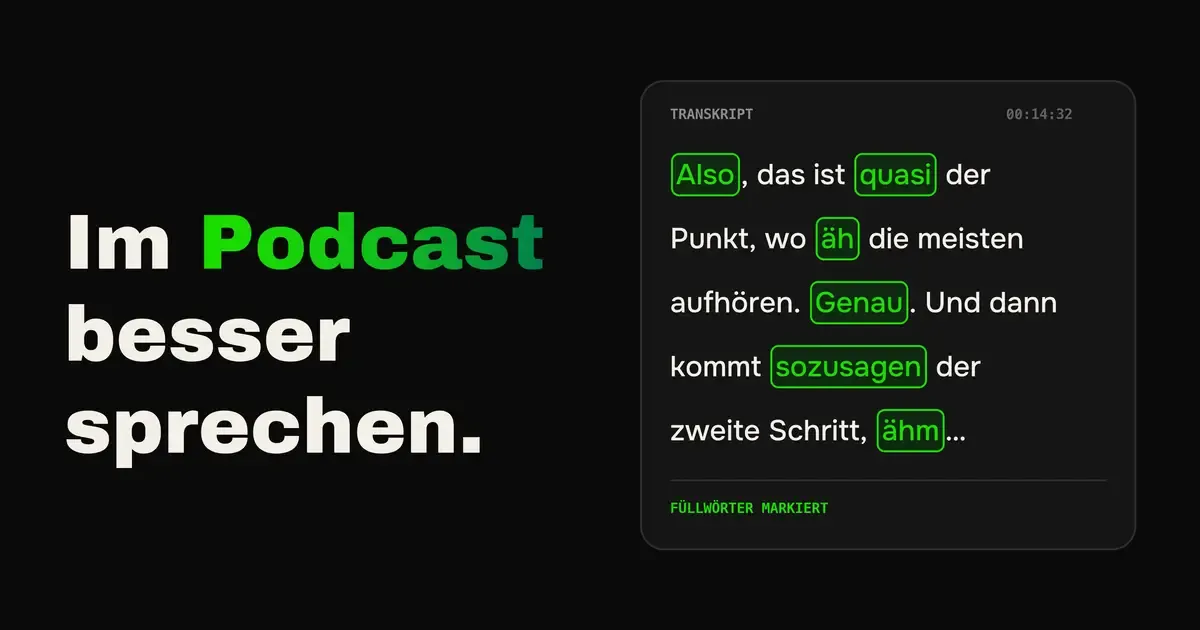
Voice, pace and rhetoric for business owners who are not professional speakers.
You do not have to be a radio announcer to make a good podcast. Your listeners want to hear your knowledge and your stance, not a perfect voice.
What you need are a few techniques. A warmed-up voice, the microphone at the right distance, a calm pace, deliberate pauses and one clear message per episode. Most of that sits after a few recordings, and the editing takes care of the rest.
Why speaking on a podcast is different
- Only the voice carries: There are no slides, no eye contact and no hands. Everything you show on a stage with face and gestures has to be in emphasis and pauses on a podcast.
- Charisma is audible: A research team around the phonetician Oliver Niebuhr acoustically compared around 45 minutes of presentations by Steve Jobs and Mark Zuckerberg (Speech Prosody, 2016). Jobs differed in almost all vocal features associated with charisma; rhythm and emphasis played a role too. Both spoke differently to customers than to investors. So charisma depends on things that can be practiced.
- You speak with one person: On a podcast nobody listens to you in a hall, but one person with headphones in their ears. Why exactly that creates so much closeness is in the article Parasocial relationships in podcasts.
Warming up your voice in five minutes
Before every recording, five minutes of warm-up are part of it, like before sport.
- Loosen up: Roll your shoulders, shake out your arms, stretch and yawn heartily while doing so. Yawning widens throat and pharynx.
- Breathe: Breathe deeply into your belly and count to four, then exhale slowly and count to eight. That way you have enough air for long sentences.
- Jaw and lips: Let your jaw hang loose and massage the chewing muscles. Then let your lips flutter like a snorting horse.
- Hum: Hum with your mouth closed and slowly transition into “nyom, nyam, nyum”. That brings the voice forward.
- Drink something warm: Put something warm to drink next to you for every recording, ideally tea with honey, and take a sip now and then.
Using the microphone right
- The distance: 5 to 15 centimeters is the guideline, closer with dynamic microphones. Make three test recordings at different distances and take the one that sounds best.
- Stay consistent: Whoever leans back or turns to the side immediately sounds quieter and more echoey. Find a position and stay there.
- The angle: If your voice sounds nasal, tilt the microphone slightly toward your chest. If you hear a pop on “P” and “B”, speak just past the microphone or use a pop filter.
- Headphones on: Whoever hears themselves immediately notices when they drift away from the microphone.
Which microphones are suitable is in the article Video podcast setup.
Pace, pauses and emphasis
- Shorter rather than faster: In a study in the Journal of Advertising Research (Rodero, 2020), 200 adults listened to ads at 160, 180 and 200 words per minute. At 180 words they processed the message best, faster cost comprehension. The author’s recommendation is to cut content instead of increasing the pace. English and Spanish ads were examined; for your podcast that is a guideline, not a rule.
- Set pauses: After an important statement, be briefly silent. The pause gives your listeners time to take in the thought, and makes it more important.
- Stress one word per sentence: Whoever stresses everything equally sounds monotonous. For your key sentences, think about which word counts, and give it weight.
- Melody instead of reading: You hear read-out texts immediately. Write yourself bullet points instead of full sentences, then you automatically speak more vividly.
Filler words and slips
- Not every “um” is a mistake: The language psychologists Herbert Clark and Jean Fox Tree showed in 2002 in the journal Cognition that “uh” and “um” are signals. They announce a short or longer thinking pause to the listener. A few of them sound natural in conversation.
- What bothers are patterns: The same word in every other sentence, such as “like”, “basically” or “you know”, or sentences that never end. That stands out, and that is exactly what you find with the bonus further down.
- Simply repeat slips: Stop briefly, breathe, say the sentence again. If you produce with us, my team and I take the failed version out in the edit.
- Do not smooth everything: A podcast without a single “um” and without laughter sounds staged. Spontaneity and small mistakes are part of what listeners find authentic about a host.
Rhetoric in conversation
- One core message per episode: Before recording, write down in one sentence what your listener should know or do afterwards. You check every digression against this sentence.
- Example instead of claim: “With a system it goes faster” does not stick. “Tim and Jan from PreSales Unleashed used to need four hours for one episode, today they produce a whole month in that time” does.
- Tell stories: A real situation with problem, turn and result carries more than ten tips.
- Good questions as a host: Ask open questions, only one at a time, and follow up with “How exactly?” or “What did you do then?”. And endure the silence after a question. The best answers often come after the pause.
- Make structure audible: Announce what is coming, say “three points on that”, and summarize at the end. Whoever only listens cannot flip back.
In a video podcast
According to YouTube, more than a billion people a month now watch podcasts there (February 2025). On video, people see you, and your body speaks too. Gestures, facial expressions and posture then belong to your message just as much as your voice.
- Gesturing is allowed: On video, viewers see your hands. Whoever hides them under the table or crosses their arms looks stiff. Talk with your hands, the way you do in conversation with a friend.
- Gestures that fit the statement: You count three points on three fingers, show a contrast with left and right, a development with an upward movement. That way the gesture underlines what you say instead of distracting from it.
- Adjust the framing: Set the camera so upper body and hands are in the frame. Framing that is too tight cuts off every gesture. How to set up camera and light is in the article Video podcast setup.
- Gestures without noise: Whoever bumps against the table or microphone arm while gesturing can be heard on the recording. Keep some space free in front of you.
- The gaze: In conversation you look at your guest. When you address your viewers directly, for example in the intro or in the call to action at the end, you look into the camera.
- Listening is visible: While your guest speaks, people see you too. Nodding, laughing and reactions show that you are really listening.
- Stillness in the frame: Stop rocking on the chair and playing with the pen. What nobody notices in audio distracts on video.
Whether video is worth it for you is in the article Audio or video podcast.
Practicing without a coach
- Listen to every episode yourself once: Take pen and paper for this and do not just listen on the side. Note the passages where you yourself would switch off.
- One thing per episode: Do not try to improve everything at once. Take on the pauses in this episode and your favorite filler word in the next.
- Warm up talking before recording: Chat casually with your guest for a few minutes before you start. Then even the beginning of the recording sounds relaxed.
- Use the transcript: What you say, you see in the text in black and white. How to turn that into concrete exercises with AI is shown in the bonus.
Bonus
The AI prompt that analyzes your episode
An AI cannot hear your recording, it can only read the transcript. So pace, pauses, emphasis and vocal tone you check yourself with headphones. Everything that is in the text, on the other hand, this prompt finds more reliably than your ear: filler words, long sentences, repetitions, unclear messages and weak questions.
You get the transcript from your recording or editing program or from a transcription service. What matters is that the speakers are labeled. It works in ChatGPT, Claude and Gemini, ideally with a model that thinks at length.
Prompt
You are a speech and editorial coach for business podcasts. You analyze the transcript of an episode and give me honest, concrete feedback so I audibly speak better in the next recording. You work only with the text. What can only be heard, you do not judge. ## My episode [Title of the episode, topic, who the podcast is for] ## My planned core message [One sentence: What should listeners know or do after this episode?] ## Who I am in the transcript [Speaker name or abbreviation, e.g. “Speaker 1”, and whether I am host or guest] ## Transcript [Paste the complete transcript with speaker labels, timestamps if available] ## Working rules – Analyze only my passages. You use the other speakers only as context, for example for my questions. – Always quote verbatim and name the location, meaning timestamp or, if there is none, the first words of the paragraph. – Count precisely. For filler words, give the count and the value per 1,000 words of my text. – Automatic transcripts sometimes omit or add filler words. Point out this uncertainty instead of making the numbers more precise than they are. – Do not judge pace, pauses, emphasis, volume or vocal tone. Instead, name passages I should listen to for those. – Invent nothing. No quotes, numbers or content that are not in the transcript. ## Procedure Step 1, check. Is it clear which speaker I am? If not, ask and wait. Name the total word count and my share in percent. Step 2, filler words and favorite words. Count typical filler words such as uh, um, like, you know, basically, actually, kind of, sort of, right, so and “and so on”. Additionally look for words and phrases I use conspicuously often, even if they are not on this list. Step 3, sentences. Calculate my average sentence length in words and name the five longest sentences. Mark sentences over 30 words and sentences that break off or restart. Step 4, content. Summarize in one sentence what the episode actually conveys, and compare that with my planned core message. Find thoughts I explain several times, and digressions unrelated to the core message. Step 5, opening and closing. Check the first 150 words: Does it become clear what it is about and why one should listen? Check the ending: Is there a summary and a concrete question or call to action for the listeners? Step 6, questions, only if I am the host. Classify my questions into open, closed, leading and double questions. Name the speaking share of me and my guest. Step 7, examples. Count how often I bring concrete examples, numbers or stories, and where I only claim abstractly. Step 8, self-check. Before output, check every number and every quote against the transcript. ## Output A. Overview: word count, my share, validity of the analysis in one sentence. B. Table of filler words and favorite words: word, count, per 1,000 words, one example with location. C. The three passages that cost the most impact, each with quote, location, why they weaken and a better phrasing in my own tone. D. Core message: planned, actual, gap in one sentence. E. A new opening for this episode in at most 60 words, in my language. F. Question check with the two weakest questions and a better version, only if I am the host. G. Three exercises for my next recording, each with a measurable goal, e.g. “like” below five per 1,000 words. H. Five passages to listen to where I should check pace, pauses or emphasis myself, with location and reason. I. Metrics for the next comparison: word share, filler words per 1,000 words, average sentence length, number of examples, in at most five lines, so I can pass them along next time. Be honest and direct, but not preachy. Reply in English.
For the next episode, include the metrics from point I in the prompt. That way you see in black and white whether you are improving.
Conclusion on speaking on a podcast
Speaking well on a podcast is not talent but practice. Whoever warms up their voice, uses the microphone right, speaks calmly, sets pauses and knows what they want to say sounds confident after a few episodes. And whoever listens to every episode themselves once gets better with every recording.
Frequently asked questions
Warm up your voice for five minutes before recording, keep the distance to the microphone constant, speak calmly and set pauses after important statements. Define one core message per episode beforehand and listen to every episode yourself once to improve one thing deliberately.
Rather calmly than hastily. In a study on audio advertising, listeners processed messages best at around 180 words per minute; faster cost comprehension. If you want to say a lot, cut the content instead of speaking faster.
Loosen your shoulders, yawn, breathe deeply into your belly, let your lips flutter and hum. Five minutes are enough. Also put something warm to drink next to you, ideally tea with honey.
5 to 15 centimeters is the guideline, closer with dynamic microphones. Make three test recordings at different distances and keep the best one throughout the whole recording.
Individual “uh” and “um” are not; they sound natural in conversation and announce a thinking pause to the listener. What bothers are patterns, meaning the same filler word in every other sentence. You find those most easily in the transcript of your episode.