How to start a podcast.
The honest guide for business owners, with lessons from more than 12 podcast launches.
Starting a podcast is not hard. You set a goal and a format, get a good microphone, record, edit, upload the episodes to a hosting provider and launch with three to five episodes plus a trailer. Around €200 is enough for the gear.
The hard part is keeping going. Most guides stop at the upload. That is exactly where most podcasters give up, because the effort is bigger than expected and the numbers smaller than hoped. My team and I have produced more than 6,300 podcast episodes and launched over twelve podcasts. So in this guide you get not just the steps but also the numbers, the time required and the schedule we use to launch podcasts for business owners.
Three numbers other guides keep from you
- The listeners are there: According to a September 2026 survey by the German digital association Bitkom, 54 percent of people in Germany aged 16 and over listen to podcasts at least occasionally.
- Most quit again quickly: According to the podcast database Podchaser, 153,767 new podcasts launched worldwide in the first half of 2026. 41.7 percent of them had already stopped by the end of June.
- Small numbers are normal: At the podcast host Buzzsprout, the median episode gets 27 downloads in its first seven days. With 96 downloads you are ahead of three quarters of all podcasts, with 412 you are in the top ten percent (as of September 2026).
For you as a business owner, this means the following. 100 downloads per episode sounds like little, but it is a full seminar room of people who voluntarily spend half an hour with your topic. You do not need millions of listeners, you need the right ones.
When you should not start a podcast
Most podcasts do not fail because of the technology but because of wrong expectations. If you recognize yourself in one of these points, do not start yet. Clear it up first.
- You want reach fast: A podcast is not a reel that gets 100,000 views overnight. It is more like a new café on your street. On opening day, friends and neighbors come. The regulars arrive over months, because one person tells the next. Whoever expects a full house after three weeks closes up again after three weeks.
- You want to make money with ads: Advertisers pay roughly $15 to $30 per 1,000 downloads, according to the 2026 benchmarks of the podcast ad network Acast. At 100 downloads per episode that is about $1.50 to $3. Advertising only pays off with a large reach. As a business owner, you earn with your podcast through clients, not through ads.
- You expect clients from the first episode: Imagine stopping a stranger on the street and asking whether they want to buy a €5,000 coaching package from you. They walk away. Not because your offer is bad, but because they do not know you. A single podcast episode is just the same. Trust builds like it does with a new accountant, over many encounters. Only once someone has listened to you for hours do they pick up the phone.
- You have neither time nor budget: A podcast without scheduled time is like the gym membership in January. For the first three weeks you go highly motivated, then everyday life gets in the way. Several hours per episode, every week: you have to be able to do that yourself or hand it off. Otherwise you join the 41.7 percent from above.
- You start because everyone has one: You would not open a shop just because three opened on your street, without knowing who is supposed to buy from you. Without a clear goal and a clear audience there is no reason why anyone should listen to you of all people.
- You want to stay in the background: A podcast makes you visible, that is exactly what it is for. Your listeners spend half an hour every week with your voice in their ears, while driving, working out, cooking. No post gets you that close. Noreen Eickenberg is now internationally known in her industry through her podcast. If that is exactly what you do not want, a newsletter or a blog is the better channel for you.
- You cannot keep a fixed rhythm: Listeners turn your podcast into a habit. Whoever listens to your new episode every Tuesday on the way to the office notices when it is missing. If it is missing twice, they have a new habit, and it is no longer you. Buzzsprout names a lack of backup episodes as one of the typical reasons podcasts quit. A vacation, an illness or a big client project is enough, and the rhythm breaks. If you cannot deliver reliably, better wait until you can.
Five decisions before the first microphone
Before you buy gear, you make five decisions. Here is my recommendation for each, for business owners who want to win clients with their podcast.
- The goal: Build the podcast around your offer, not around a topic that happens to interest you right now. You speak as an expert from your niche for your niche. How to find it is covered in the article Finding your podcast niche.
- The format: My recommendation is an interview podcast with guests from your target audience or your network. Every conversation is a relationship with a potential client or partner. Our clients Margarethe Honisch and Noreen Eickenberg win new clients several times a month through their podcasts, from guests as well as from listeners.
- The rhythm: Publish weekly or every two weeks, but reliably. At the podcast PreSales Unleashed, downloads tripled once the episodes came out regularly.
- The length: As long as the conversation carries. My guideline is 30 to 60 minutes, in special cases 90. At Buzzsprout, 20 to 40 minutes is the most common length, so you do not have to stretch artificially.
- Audio or video: Choose video if YouTube and short clips for social media are part of your marketing. Otherwise start with audio. The honest trade-off is in the article Audio or video podcast.
How to turn this into a complete concept is what I show you in the article A podcast concept in 9 steps.
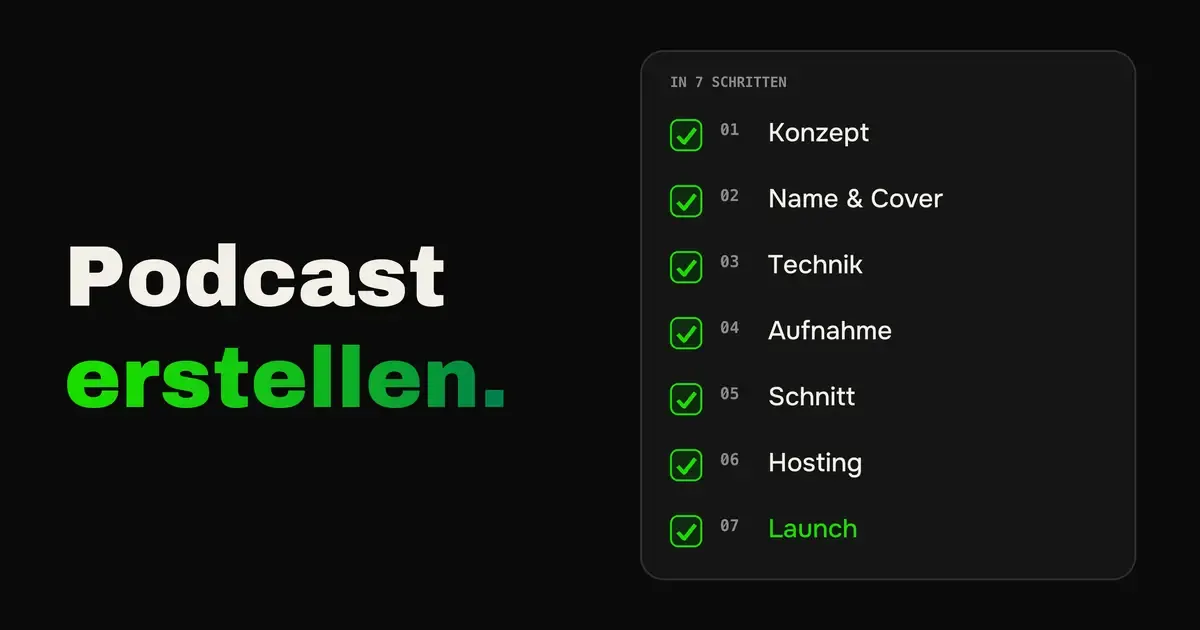
The seven steps at a glance
| Step | What you do | My recommendation |
|---|---|---|
| 1. Concept | Goal, audience, format, rhythm, first topics | Plan the first ten episodes before you record the first one. More on that in the editorial calendar article |
| 2. Name, cover, intro | Check the name, design the cover, decide on intro and music | Cover at 3000 × 3000 pixels, test it at thumbnail size, royalty-free music only. Everything about the podcast cover |
| 3. Gear | Microphone, headphones, for video camera and light | USB microphone from about €110 to start, two dynamic microphones for two people. Everything in the equipment article |
| 4. Recording | Alone, with a co-host in the same room or with remote guests | Every voice on its own track, guests via Riverside. Here is how: Recording a podcast remotely |
| 5. Editing | Remove slips and pauses, level the volume, add intro and outro | Practice for free with Audacity or GarageBand, then hand it off. Podcast editing service |
| 6. Hosting | Choose a host, submit the feed to Spotify, Apple and the others | A hosting provider from about €9 a month, free is possible with Spotify for Creators. The hosting comparison |
| 7. Launch | Publish trailer and launch episodes, promote them | Three to five episodes plus a trailer on launch day or during launch week |
Approximate prices, approximate and subject to change.
The part almost everyone underestimates
The gear is bought in a week. What most people underestimate is the work around every single episode.
- Before: Find and invite a guest, agree on a date, brief the guest, prepare questions, check the gear.
- During: Test recording, recording, saving the files and waiting until your guest’s upload is finished.
- After: Editing, intro and outro, volume, show notes, title, episode artwork, upload, plus thumbnail and clips for video, then promoting the episode.
My team needs roughly one hour of post-production for half an hour of audio, sometimes more, sometimes less depending on the effort. Anyone doing this for the first time needs a multiple of that, because they lack practice and tools. So expect several hours per episode, every week. What that means over a year is covered in the article Editing your own podcast.
It does not have to stay that way. Tim and Jan from PreSales Unleashed used to need about 4 hours for a single episode. With a fixed production system, about 4 hours now produce the content for a whole month. It took about six weeks until the system ran smoothly.
So the honest question is whether you want to do this work yourself. You do not teach yourself bookkeeping just because you theoretically could. What doing it yourself and outsourcing cost is in the article How much does a podcast cost?, and how to recognize a suitable agency in the article Finding the right podcast agency.
The launch roadmap in 30 days
This is how we launch podcasts for business owners in 30 days. You can work through the same plan on your own, it usually takes a bit longer then.
| When | What happens |
|---|---|
| Week 1 | Define the concept, collect your audience and their questions, plan the first five episodes, make a test recording and evaluate it |
| Week 2 | Choose and set up the gear, decide on name, cover, description and music, produce intro and outro |
| Week 3 | Record trailer and three to five episodes, edit, write show notes, inform guests about the launch date |
| Week 4 | Set up the host, submit the feed to Spotify, Apple and the others, prepare the YouTube channel for video, create banners and social media templates |
| Launch day | Publish trailer and launch episodes, newsletter, LinkedIn and Instagram, write to clients and guests personally |
| The weeks after | Keep publishing in a fixed rhythm, post clips, reply to every listener message |
Better submit your feed a few days before launch. The platforms review new podcasts first, and on launch day you do not want to be waiting.
What is realistic in the first 90 days
- The numbers grow slowly: A new podcast has no listeners waiting for it. They come through your guests, your network and with every episode that gets found. So compare your numbers with the Buzzsprout figures above, not with the big shows.
- The impact comes with a delay: Listeners often only get in touch after several episodes, seemingly out of nowhere, by email, via Instagram or in the intro call. That is exactly what happens for Noreen Eickenberg, across all channels.
- Count the right things: For business owners, inquiries, conversations and guests who become clients count more than downloads. What your statistics really mean is in the article Understanding podcast statistics.
- Get a second opinion: Whoever has nobody to ask to put the numbers in context quickly mistakes a normal starting phase for failure. With someone at your side who knows what matters, you make safer decisions and keep going.
Two podcasts that started exactly like this
Dein Höhenweg: Noreen Eickenberg is a sports mental coach in equestrian sport. When she came to us, she had no technical knowledge. “I was pretty clueless and overwhelmed by everything,” she says today. We guided her from the first step to launch, with a production plan, gear and publishing, and all she had to do was concentrate on her interviews. Today her podcast has more than 130 episodes and over 150,000 downloads, is financed by sponsors and brings her new inquiries every month.
Fortunalista, the finance podcast: Margarethe Honisch, finance expert and bestselling author, wanted to extend her financial education platform with a podcast but had neither the time nor the technical knowledge for it. Instead of editing episodes in the evening, she handed structure, editing and upload to us. Today she has over 100,000 downloads, more than a million views on YouTube and 50 percent more sign-ups for her bootcamp. The podcast is financed entirely by advertising partners.
Neither started with a big reach. What they have in common is a clear topic for a clear audience, a fixed rhythm and someone who takes the technology off their hands.
Can I create a podcast with AI?
Yes, but not the one you need as a business owner. Tools like Google’s NotebookLM turn documents into a conversation between two AI voices, and since 2025 in German as well. That is handy for learning, and Google itself points out that these summaries can contain errors.
A business podcast works because people listen to you. Your voice, your stance and your stories build trust that no AI voice replaces. Why that is so is covered in the article Parasocial relationships in podcasts. Where AI really takes work off your hands, namely show notes, transcripts and clips, is what I show you in the article Podcast automation with AI.
Bonus
Launch your podcast with us
So you do not forget anything at launch, my team and I can set up the whole start with you: concept, gear, branding, hosting and your first three episodes, done in 30 days.
Conclusion on starting a podcast
You can start a podcast in 30 days. Keeping it going for a year is the real task. Whoever knows their goal, plans the effort honestly, launches with three to five episodes plus a trailer and reads their numbers correctly does not belong to the 41.7 percent who quit after a few months.
Frequently asked questions
It takes seven steps. You define the concept, design name, cover and intro, get the gear, record, edit, upload the episodes to a hosting provider and launch with three to five episodes plus a trailer. Through the host’s RSS feed, your podcast lands on Spotify, Apple Podcasts and the other platforms.
You need a good microphone, wired headphones, editing software and a podcast host. For an audio podcast, about €200 is enough for the gear. For video, a camera or webcam and lighting are added.
Anyone doing everything themselves should expect several hours per episode, for guest planning, recording, editing, show notes and publishing. A practiced team needs roughly one hour of post-production for half an hour of audio. With a fixed system or an agency, your own effort drops to about one hour per week.
With three to five episodes, ideally all on launch day or during launch week, plus a short trailer. That way new listeners can keep listening right away and immediately know what it is about and who you are.
Fewer than most people think. At the host Buzzsprout, the median episode gets 27 downloads in its first seven days. With 96 you are ahead of three quarters of all podcasts, with 412 you are in the top ten percent (as of September 2026).